The Ukrainian diaspora in Canada has reached a new phase of its historical development. While Ukrainian Canadians have been present for more than a century, recent geopolitical events, large-scale migration and evolving Canadian policies have reshaped the community's structure, priorities and public role. As our article on Ukrainians in Canada and their 130-year history explains, the Ukrainian diaspora today is more visible, more diverse and more influential than ever before. In 2026, more than 300,000 people in Canada have direct Ukrainian roots, and another million have partial Ukrainian ancestry, placing Ukrainians among the largest ethnic communities in the country.
In brief: The Ukrainian diaspora in Canada is a multi-generational community of over 1.3 million people spread across every province. Shaped by five waves of immigration spanning more than 130 years, Ukrainian Canadians are deeply integrated into the social, economic and political fabric of the country while maintaining strong cultural traditions and ties to their homeland.

A Diaspora Shaped by Multiple Generations
One of the defining characteristics of the Ukrainian diaspora in Canada is its multi-generational composition. The community now includes descendants of early settlers who arrived in the late 1800s (third to fifth generation), families of post-World War II immigrants, economic migrants from the 1990s and 2000s, and recent arrivals displaced by the conflict in Ukraine. These groups differ significantly in language proficiency, political views and cultural practices, creating a diaspora that is heterogeneous rather than monolithic.
The first Ukrainian settlers in Canada were Ivan Pylypiv and Vasyl Yeleniak, both from the village of Nebylov in what was then Austro-Hungary (now Ivano-Frankivsk Region). Pylypiv founded the settlement of Edna-Star in Alberta, the very first and largest group settlement of Ukrainians in Canada. The initiator of mass migration was Dr. Joseph Oleskiv, who stimulated and popularized emigration to Canada from Western Ukraine, Galicia and Bukovina in the late 1890s.
Historical Reasons for Ukrainian Emigration to Canada
The history of Ukrainian emigration to Canada can be divided into five distinct waves, each driven by different circumstances. Understanding these waves is essential to appreciating the complex relationship between Canada and the Ukrainian diaspora.
The first wave began at the end of the 19th century, when Ukrainian farmers sought to escape the heavy taxes imposed by the Austro-Hungarian government. They were attracted by the absence of taxes in Canada and the availability of free land on the western prairies. These immigrants settled in remote areas with their families, forming small self-sufficient communities. Rapid adaptation was facilitated by their ability to settle together, retain their language and organize cultural institutions.
The second wave came after World War I. The rural way of life became less appealing, and many Ukrainian immigrants began to move to large cities and industrial centres such as Toronto and Montreal. This shift marked a transition from agricultural to urban employment.
The third wave was driven primarily by political motives following World War II. These were mostly displaced persons and repatriates from the British, American and French occupation zones who opposed Soviet rule.
The fourth wave, often called the "labour migration wave," began in the 1990s and was caused by the economic difficulties of the transitional period in independent Ukraine.
The fifth wave began after the events in Ukraine in 2013-2014 and has accelerated dramatically since 2022, bringing tens of thousands of refugees and displaced families to Canadian cities.
Canadian Provinces for Ukrainian Emigration
The choice of province for emigration depends on the migrant's goals. Canada has both federal and regional immigration programmes. Federal programmes include refugee and humanitarian programmes, family sponsorship and reunion, business immigration and skilled worker streams. Each Canadian province also has its own customized immigration programme designed to select immigrants who best meet the local economic needs.
Alberta is one of the historical heartlands of Ukrainian settlement. Currently home to approximately 332,000 Ukrainians (about 9% of the provincial population), the province offers strong economic opportunities, particularly in Calgary and Edmonton. Alberta's Ukrainian churches, museums and cultural festivals are deeply embedded in the provincial landscape.
Ontario is the most populated province and home to roughly 336,000 Ukrainians. Toronto, Canada's largest city, and Ottawa, the national capital, are major centres for Ukrainian media, professional networks, churches and student organizations. For those pursuing education, Ontario offers diverse programmes and scholarship opportunities.
Manitoba, in the centre of the country, has long been one of the most important centres of Ukrainian culture outside Ukraine. With approximately 167,000 residents of Ukrainian origin, Winnipeg remains a historic hub for Ukrainian cultural, educational and political activity. To understand the historical context behind these settlement patterns, see our article on 130 years of Ukrainian immigration to Canada.
Saskatchewan has a proportionally large Ukrainian population at nearly 12% (roughly 129,000 people). The economy is heavily agricultural, with nearly half of all Canadian wheat grown in this province. Ukrainian farming traditions have deep roots here.
British Columbia hosts about 197,000 Ukrainians (4.4% of the population). The province is well suited for labour migration, with an economy based on natural resources, international trade and transportation.
Quebec, where French is the official language, has a smaller Ukrainian community of approximately 32,000 people. However, Montreal has seen recent growth, particularly among young professionals and students. The economy features aerospace, biotechnology, pharmaceuticals and IT sectors.
For a detailed look at how the community of Ukrainians is distributed across Canadian cities, including Toronto's Etobicoke, Mississauga and North York neighbourhoods, see our dedicated article.
Language Use and Cultural Identity
Language plays a central but evolving role in the Ukrainian diaspora. While older generations and recent refugees are more likely to speak Ukrainian or Russian at home, many long-established Ukrainian Canadians primarily use English or French. Ukrainian language schools remain active but selective, and cultural identity is often expressed symbolically rather than linguistically. Hybrid identities labelled "Ukrainian-Canadian" now dominate, reflecting successful integration without complete cultural assimilation.
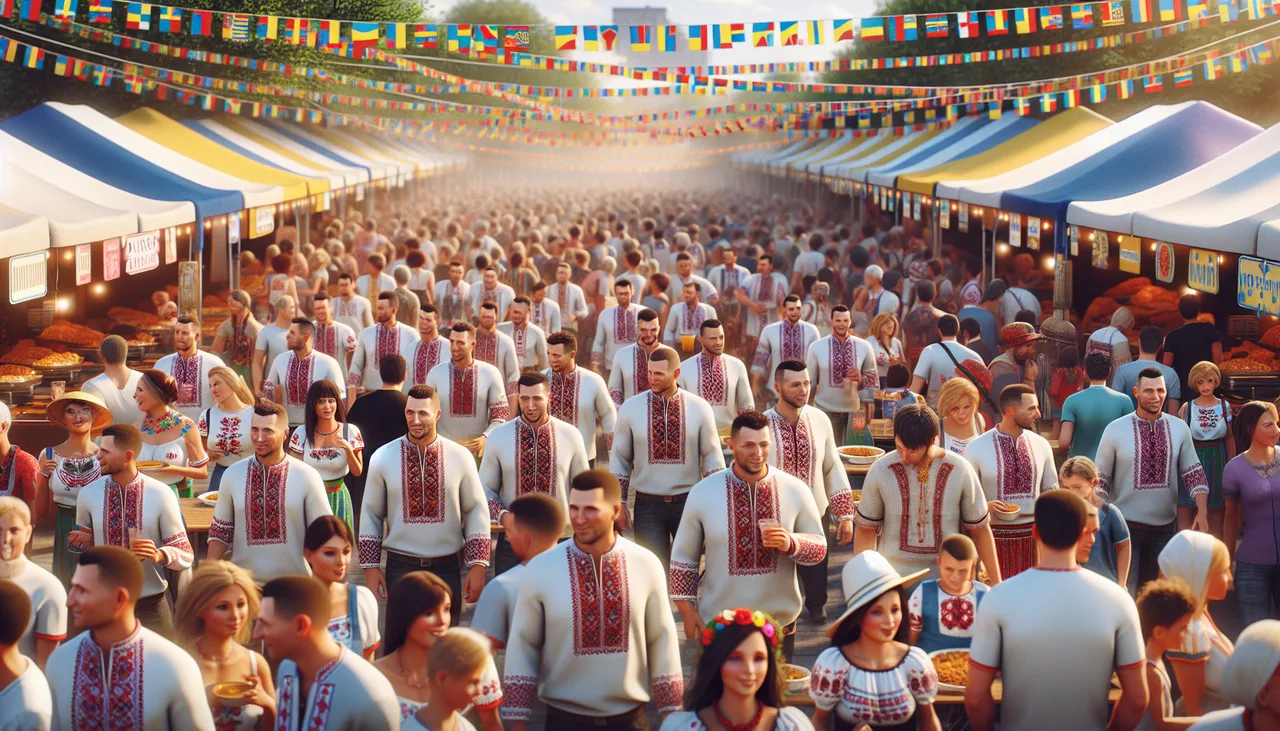
Traditional holidays, music, dance and cuisine remain central to community identity. Ukrainian churches, both Orthodox and Greek Catholic, continue to play an important role in social cohesion. Cultural festivals, youth organizations such as PLAST and the Ukrainian Youth Association, and community centres help transmit Ukrainian heritage to younger generations born in Canada. Not a single national parade in Canada passes without a Ukrainian column, with participants dressed in embroidered shirts and traditional garments.

Economic Integration and Professional Profiles
Ukrainians in Canada are well integrated economically. The diaspora includes highly skilled professionals in IT, engineering and healthcare, entrepreneurs and small business owners, and blue-collar and service-sector workers among newer arrivals. While credential recognition remains an issue for some newcomers, overall employment rates among Ukrainian immigrants are relatively high compared to other recent refugee groups. Many recent arrivals have pursued retraining programmes to adapt their qualifications to the Canadian job market.
The Ukrainian community also benefits from strong professional networks and business associations. There are specialized communities dedicated to developing trade relations between Canada and Ukraine, which can assist with finding partners, securing contracts and navigating the Canadian business environment. As the Ukrainian community in Toronto continues to grow, new economic opportunities are emerging in technology, finance and the creative industries.
Political Influence and Civic Participation
The Ukrainian diaspora in Canada has developed a structured and institutionalized political presence. Unlike informal or radicalized diaspora movements seen elsewhere, Ukrainian Canadian activism operates largely within established democratic frameworks. Ukrainian Canadians are represented at municipal, provincial and federal levels, with notable figures including William Hawrylak, Edward Stelmach and Ramon Hnatyshyn. Advocacy groups work closely with Canadian institutions, and political discourse is increasingly professionalized and strategic.
The Ukrainian Canadian Congress (UCC) serves as the primary umbrella organization bringing together political, social and cultural organizations. The war in Ukraine since 2022 has further galvanized political engagement, with large-scale humanitarian fundraising, refugee sponsorship and increased media presence becoming standard activities across the diaspora. The conflict has also reshaped international alliances and diplomatic relationships across Europe, with Canada playing an increasingly visible role on the world stage alongside its European partners.
Ukrainian Community and Mutual Aid
The Ukrainian diaspora in Canada actively lobbies for the interests of their historic homeland, including at the government level. Community members try to instill in the younger generation a love and respect for traditions. The diaspora can help newcomers with obtaining letters of support for employment, though the process can be complicated and time-consuming. Various associations support Ukrainian entrepreneurs, and specialized communities facilitate trade relations between Canada and Ukraine.
One of the most important factors attracting migrants from Ukraine is the strong support network of the diaspora. Ties within the community are well developed, extending to practical assistance such as helping newcomers secure mortgages on more favourable terms. No matter which city you move to, you can find compatriots ready to help with adaptation, household issues and more serious challenges.
Last year the United Nations officially recognized Canada as one of the best countries for emigration, citing the high standard of living, quality social security available with a residence permit, and flexible immigration policy. Just three years after emigration it is possible to obtain Canadian citizenship.


Pros and Cons of Living in Canada
Every decision has trade-offs, and emigrating to Canada is no exception. On the positive side, a permanent residence permit makes you almost a full member of society in a country with a very high standard of living, low crime rate and clean environment. Free education, unemployment benefits and quality healthcare become available. Canada's multicultural and tolerant society makes adaptation relatively smooth, especially with the support of the Ukrainian diaspora.
On the other hand, the high standard of living involves high taxes and expensive private medical services not covered by the public system. The Canadian climate is famously challenging, particularly in the prairie provinces and northern regions. Housing costs in major cities like Toronto and Vancouver have risen dramatically. Knowledge of English or French is obligatory for meaningful integration, and credential recognition can delay career advancement for professionals.
Common Mistakes to Avoid
Based on the experience of Ukrainian immigrants who have settled in Canada over the past three decades, several common mistakes can be identified. First, many newcomers underestimate the importance of language preparation. While the Ukrainian community provides excellent support, professional advancement requires strong English or French skills. Second, some immigrants choose a province based solely on the diaspora size rather than economic opportunities matching their skills. Third, failing to begin the credential recognition process before arriving in Canada can waste valuable months. Fourth, neglecting to connect with the Ukrainian Canadian Congress and local diaspora organizations means missing out on essential settlement resources. Finally, some newcomers isolate themselves within the Ukrainian community and delay broader integration into Canadian society.
Province Comparison Table
| Province | Ukrainian Population | % of Province | Key Industries | Best For |
|---|---|---|---|---|
| Alberta | 332,000 | 9% | Energy, agriculture, technology | Established diaspora, strong economy |
| Ontario | 336,000 | 2.5% | Finance, technology, education, healthcare | Education, careers, urban life |
| Manitoba | 167,000 | 12% | Agriculture, transportation, mining | Cultural hub, affordable living |
| Saskatchewan | 129,000 | 12% | Agriculture, mining, energy | Farming, tight-knit community |
| British Columbia | 197,000 | 4.4% | Resources, trade, technology | Labour migration, mild climate |
| Quebec | 32,000 | 0.4% | Aerospace, biotech, IT | French speakers, students |
Frequently Asked Questions
How many Ukrainians live in Canada?
More than 1.3 million Canadians claim Ukrainian ancestry. Of these, approximately 350,000 have both Ukrainian parents, and over 950,000 have at least one Ukrainian parent. This makes Ukrainians one of the largest ethnic communities in Canada.
Which Canadian provinces have the most Ukrainians?
The three most popular provinces for Ukrainian settlement are Alberta (about 332,000 Ukrainians, 9% of the population), Ontario (336,000), and Manitoba (167,000). Saskatchewan also has a significant proportion at nearly 12% of its population.
What are the main waves of Ukrainian immigration to Canada?
There have been five major waves: farmers from Austro-Hungary in the late 1800s, post-World War I urban migrants, post-World War II political refugees, economic migrants from the 1990s, and recent arrivals displaced by the conflict in Ukraine since 2014.
Does the Ukrainian diaspora in Canada have an official website?
The Ukrainian diaspora has no single official website, but the Ukrainian Canadian Congress (ucc.ca) serves as the primary umbrella organization. The Ukrainian Embassy in Canada website also provides useful resources for migrants.
What challenges do Ukrainian newcomers face in Canada?
Key challenges include housing shortages in major cities, credential recognition for professional qualifications, psychological trauma linked to war displacement, differences in cultural expectations and workplace norms, and adapting to the Canadian climate.
Where do most Ukrainians live in Manitoba?
Most Ukrainians in Manitoba are concentrated in Winnipeg, which has been a historic hub for Ukrainian cultural, educational and political activity since the early 1900s. With approximately 167,000 residents of Ukrainian origin, Manitoba has one of the highest proportions of Ukrainians in Canada at about 12% of the provincial population.
How does the Ukrainian diaspora in Canada maintain its cultural identity?
The Ukrainian diaspora maintains its cultural identity through a network of Ukrainian Orthodox and Greek Catholic churches, language schools, folk dance ensembles, choirs, cultural festivals and youth organizations like PLAST. Canada's official multiculturalism policy supports the legal right to preserve cultural values and pass on heritage and traditions to future generations.